City tariffs at a level required to keep municipality healthy enough to deliver services
03 September 2021
The City of Cape Town uses all income from tariffs for the provision of services. It does everything in its power to keep tariffs as affordable as possible to cover the cost of providing the services, while making sure the income is sufficient to ensure the municipality can continue providing services sustainably. Without this necessary income, the City will not be able to provide services. Eskom’s massive price hike has resulted in a substantial increase in the cost of electricity this year. It now costs the City 17,8% more to buy electricity from Eskom. Because of this increase, the City was compelled to implement a 13,48% electricity increase from 1 July 2021. Nevertheless, the City has absorbed more of the price hike than any other metro in South Africa – where the average increases are 14,59%.
The City absolutely rejects any misinformation being spread by certain groupings about the City’s tariffs and rates, despite numerous efforts by the City to correct the misinformation. It is very clear if one actually looks at the data that the City’s tariffs are fair, as affordable as possible and at a sustainable level to ensure the municipality is healthy and can carry on delivering services, paying Eskom for electricity bulk purchases and all other major input costs.
Electricity
It is only if Eskom has competition that we will see a real impact on household electricity prices.
The City’s lowest tariff level is the cheapest among the metros. This is due to the hard work that the City has done to keep tariffs as affordable as possible by increasing efficiencies over the years. The purple line which represents Cape Town is consistently the lowest at the lower end of the usage bands. Although it is not a straightforward comparison to make as there are different tariff bands and customers bases for all these metros, if you are supplied by the City of Cape Town, inclusive of the fixed component of the tariff, you still generally receive more units than in Joburg, especially when you use less. For example, for the City of Joburg, the equivalent fixed charges per month amount to R768,21 (incl. VAT). This does result in lower per kWh charges, so which metro is cheaper depends completely on the amount of energy consumed – again consumers who use less will pay less in Cape Town. The City thus always actively encourages customers to use less and pay less.
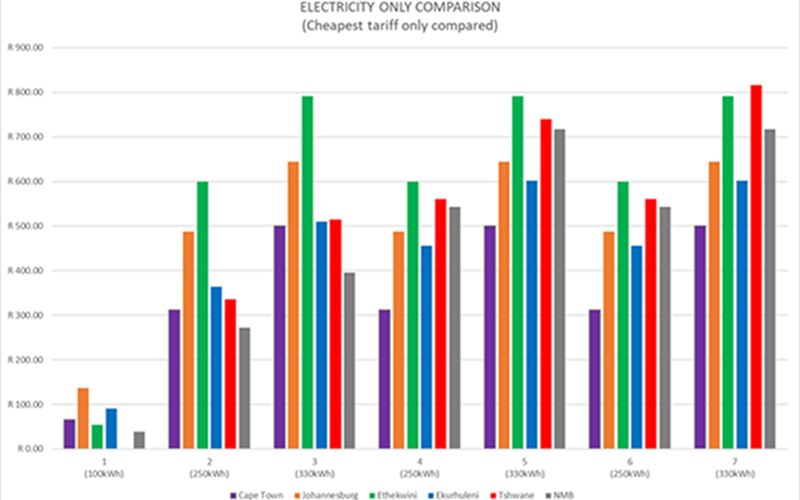
Note: Scenarios 1 to 3 above are for informal areas, 4 to 7 are for formal areas, with different levels of income assumed as this impacts what relief is available in many metros.
Some 27,4 % or 163 335 of the City’s average residential customer base is on the Lifeline tariff. This is among the highest proportion of households receiving help for any metro in South Africa (Gauteng average is 15,9%). Some 26,4% or 157 352 of the City’s average residential customer base is on the Domestic tariff.
In the 2021/22 financial year, a budgeted amount of approximately R11,2 billion (2020/21: R9,6 billion) will be spent out of a total operating expenditure of R13,8bn (2020/21: R12,3 billion). A R1,6 billion increase in bulk purchases from Eskom therefore results in a R1,5 billion overall operating expenditure increase for the City. This means that overall, other City distribution related costs have actually gone down for the 2021/22 financial year by R100 million. The City has done everything possible to reduce its own expenditure to keep the tariffs as low as possible, without contributing to the R35 billion plus owed to Eskom by other municipalities (as was published in their financial statements), and without having to reduce service delivery levels (as has been seen in the City of Johannesburg, which experiences regular, large-scale outages - about four times as often as in Cape Town).
Fixed parts of the tariffs
The fixed part of the electricity and water tariffs forms part of the overall tariffs. This is not only the case in Cape Town but also in the rest of the country, as it ensures that income is stable, irrespective of how much or how little is used. This enables a service provider such as the City to provide reliable services – getting enough income to provide the service and being able to absorb shocks caused by a large drop in usage without service provision being disabled.
Importantly, registered indigent households do not pay the fixed part of the tariff.
Electricity
‘As it pertains to electricity, there is an erroneous assumption that all the fixed costs are recovered from customers via the fixed monthly service charges. This is not the case. The actual fixed cost attributable to residential customers amounts to around R385 per month, or roughly double the current level (R168,95 per month),’ said the City’s Mayoral Committee Member for Energy and Climate Change, Councillor Phindile Maxiti.
Water
‘When it comes to water, the fixed part recovers approximately 20% of the fixed cost. It does however help to stabilise revenue streams so that changes in usage patterns, as with a drought response, do not negatively impact service operations and maintenance programmes. If the fixed portion of the tariff model was removed, the usage part of the tariff will need to be increased significantly to compensate.
‘All water and sanitation revenue is used to cover the costs of delivering a reliable service and building a more resilient water service through our New Water Programme, which aims to produce approximately 300 million litres (Ml) per day through groundwater abstraction, desalination and water re-use by about 2030. The service also includes the treatment and scientific quality testing of water; operation, repairs and maintenance of infrastructure; and transport and treatment of wastewater,’ said the City’s Mayoral Committee Member for Water and Waste, Alderman Xanthea Limberg.
Competition for Eskom would help households
‘The design of tariffs is no simple exercise. There are multiple factors that come into play in the determination of the costs. Consideration needs to be given to the requirements for all customer categories, the specific needs of the business, and what legislation and regulatory guidelines are provided in any given year. It is not simply a case of taking the input Eskom cost, add a percentage, and the tariff is done. Each stakeholder group (different levels of customers) has its own specific requirements in any given year, and balancing those requirements to the satisfaction of all is a near impossibility.
‘Electricity is becoming an increasingly expensive commodity. Of that there is no doubt. It is only if Eskom has competition that we will see a real impact on household electricity prices. The City has done, and continues to do, everything in its power to keep these prices in check as much as possible, in the most fair way possible. Reducing the price (or not increasing the price as much) for any one customer category has a resultant knock on effect elsewhere, for some other customer category, and these impacts must also be considered. The City has help available to indigent customers as well as those who have been severely affected by Covid-19 and the lockdowns. All applications are evaluated on a case-by-case basis. The City currently has a 97% payment ratio, which indicates most ratepayers are able to pay their municipal accounts and those who can’t, can approach us for assistance,’ said the City’s Mayoral Committee Member for Finance, Alderman Ian Neilson.
Help and deductions for arrears
‘About 40% of people in Cape Town get support with rates and services, and City rentals. The City understands the plight of many customers who have been severely affected by the Covid-19 pandemic and lockdown and has availed assistance on a case-by-case basis. Separate indigent and pensioner rates relief is also available,’ said Alderman Neilson.
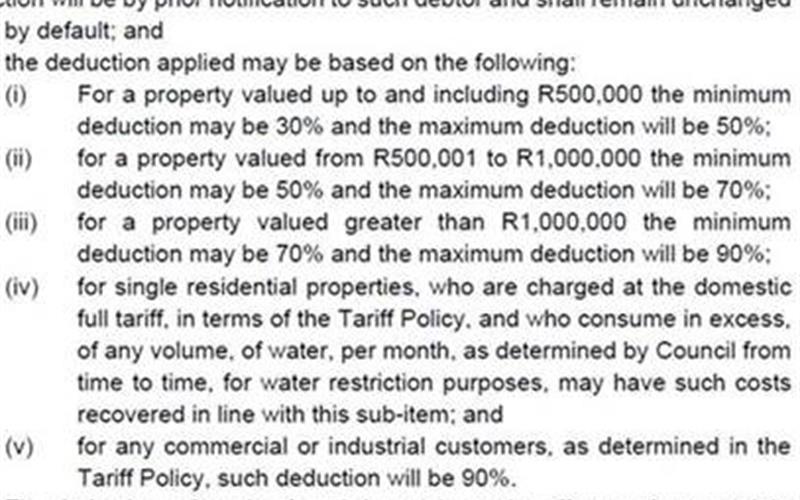
In terms of the City’s Credit Control and Debt Collection Policy, deductions for municipal arrears debt via electricity purchases are permitted if, after warnings and notification to the debtor, no action has been taken by the debtor to approach the City for assistance and to agree to a valid payment arrangement.
Instead of disconnecting the electricity supply (as happens with a non-prepaid electricity meter), deductions (when purchasing electricity through a prepaid meter) are only made if:
- There is no payment arrangement in place despite warnings and notifications.
- There is a payment arrangement in place, but it is not valid as it is not being adhered to by paying in full the monthly agreed-to payments and keeping to the agreement.
- Ad hoc payments are being made but there is no formal arrangement with the City.
- An account possibly has a tampering charge on it from a previous investigated tampering incident, that would be deducted via the electricity purchase, where relevant.
Extract from the policy:
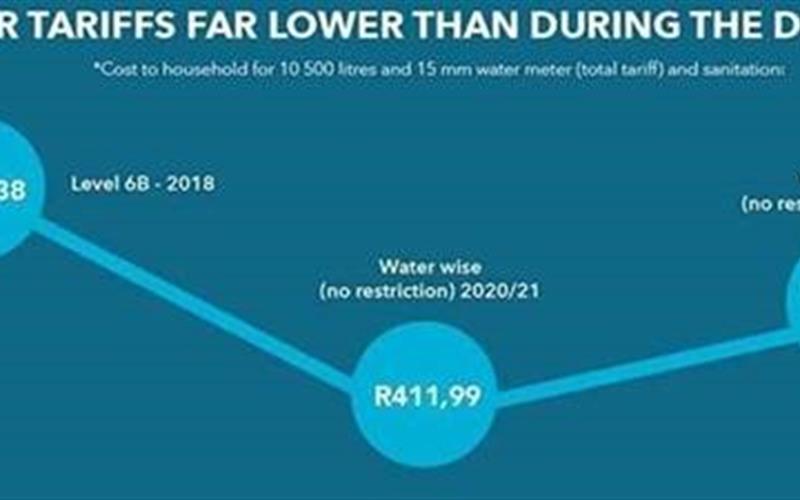
Water tariffs substantially lower than during the height of the drought
 Income from the tariffs are used for this:
 Water
• City water (including sanitation services) costs approximately 4c per litre* compared to around R10 per litre for shop-bought bottled water (*based on first 10 500 litres used and 15mm water meter).
• The City does not budget for a profit from the sale of water and seeks to keep costs of service delivery as low as possible.
• Cape Town’s registered indigent residents are provided the largest water and sanitation allocation, at no charge to the household, in the country.
• 40% of households in Cape Town receive water and sanitation services free of charge.
As dams are now full, some residents might be questioning whether water tariffs can be lowered to pre-drought levels, when all households, both indigent and non-indigent, were provided six kilolitres of water per month, at no charge.
Prior to the drought, water purchases by those using high volumes of water allowed for the first six kilolitres of water to be subsidised. Water usage habits have remained significantly lower than they were before the drought, and there are very few customers today who purchase the volumes of municipal water that enabled a subsidised allocation. The changing circumstances placed the sustainability of the previous tariff model at risk, and left the water and sanitation service vulnerable to climate shocks. It was necessary to build resilience into the tariff model, while adjusting the price of water to a more cost-reflective level. For this reason, the City introduced the tariff model comprising a fixed component, and a (variable) usage component. This provides a degree of security to a sustained operation of the vast water and sanitation service.
Also, it is important to keep in mind that the amount of water in our dams, which we share with several other municipalities, does not directly influence the cost of delivering the overall water and sanitation service. The direct impact relates to the volumes used to recover the cost. The relationship between the volumes used and low dam level however becomes critical when managing a drought.
CITY HELPING - Continued Covid-19 relief for residential and non-residential ratepayers
- Postponing the General Valuation
- R3,4 billion rates and services relief for qualifying residents
- R4,1 billion debt write-off incentive for residential and non-residential customers
- R8,3 billion capital budget to help boost local economy
- R460 million cut in staffing and contract services; no senior staff performance bonuses
| SOME UTILITY SERVICES WE OFFER - Maintaining 200 000 residential refuse bins per day;
- Maintaining an 11 500 km water and 9 500 km sewer network,
5 600 km of stormwater pipelines, 490 waste water pump stations, 23 waste water treatment works and 180 reservoirs; - Servicing 672 001 metered water customers;
- Maintaining more than 666 500 electricity meters, servicing about 86 high-voltage substations and
14 443 km of lines and cables; - Servicing 9 990 substations and maintaining 60 179 low voltage kiosks; and
- Protecting City-supplied customers from Eskom’s load-shedding where possible.
|
Please see this myth and misinformation release for more information: https://www.capetown.gov.za/Media-and-news/Electricity%20tariff%20myths%20busted%20and%20misinformation%20fact%20checker
More information about the City’s Water Strategy can be found here: http://www.capetown.gov.za/general/cape-town-water-strategy
End
Published by:
City of Cape Town, Media Office